Key Takeaway
Replacing vinyl siding typically costs between 30% and 50% of your total project budget in labor alone, and the final price depends on your home’s measured exterior wall square footage, not its floor area. The cost to replace vinyl siding also shifts with tear-off fees, trim scope, substrate repairs, and the grade of panel you choose. No published average reflects your specific house. Get an itemized on-site estimate to see a dependable number.
The cost to replace vinyl siding is driven by your home’s measured exterior wall square footage, the complexity of its design, removal and disposal of the old panels, the trim and flashing scope, wall preparation, the siding material you choose, and whatever damage turns up after tear-off. No online calculator can see your walls. The only dependable number comes from an itemized on-site estimate that states clearly what is and is not included.
If you’re looking at brittle, faded panels and trying to plan a decision that will outlive the next two decades, you deserve more than an average. Below is how siding replacement cost is actually calculated, which line items separate a complete bid from an incomplete one, and how to compare siding installation estimates on identical scope instead of guessing.
Why There’s No Single Price for Replacing Vinyl Siding
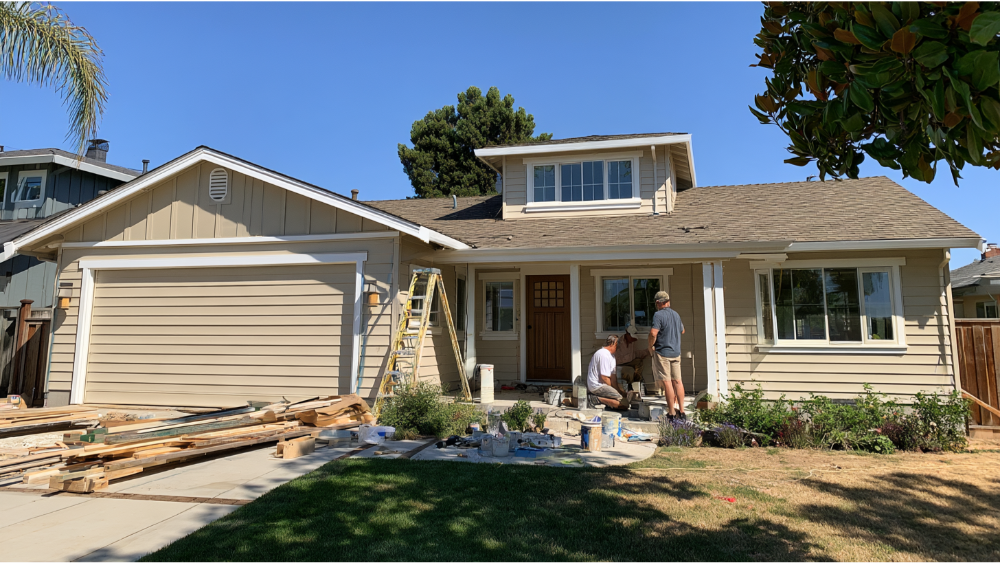
Published national averages diverge for predictable reasons. Each one assumes a different house size, a different siding grade, and a different answer to whether tear-off, disposal, and substrate repairs are included. Many of those pages exist to collect your ZIP code, not to produce a standardized construction takeoff. Vinyl siding alone spans a wide quality range, from thin builder-grade panels to heavy-gauge insulated profiles, and the cost per square foot installed moves with it. Heavier, thicker panels resist impact and buckling better than the lightest profiles, and they price accordingly. What homeowners pay for the same wall area also shifts from one market to the next.
So the average tells you very little about the actual cost on your house. The useful question is a different one: what scope of work am I paying for, and what could legitimately change it once the panels come off? That question has an answer you can verify.
While the total price is specific to your house, a handful of planning percentages are consistent enough to budget around. Here is how the figures cited throughout this article fit together.
| Planning Figure | Typical Range | What It Represents |
|---|---|---|
| Material waste allowance | About 10% | The common planning allowance when estimating vinyl siding quantities, per the JLC field guide. Cut-heavy elevations and specialty profiles push it higher. |
| Labor share of total project cost | 30% to 50% | The portion of the project tied to crew hours. Complex homes land at the upper end. |
| Concealed-damage contingency | 10% to 15% | Standard planning advice for sheathing repair, flashing corrections, and conditions found only after tear-off. |
| Modeled national cost recovery | 97% vinyl / 114% fiber cement | 2025 Cost vs. Value report figures for a standardized 1,250 square foot wall project. Modeled averages, not a promise for your sale. |
How Is Siding Measured? Exterior Wall Square Footage, Not Floor Area
Siding is estimated from the surfaces being covered, not from the home’s interior square footage. This is where most homeowners get tripped up. Two homes can both be described as 1,500 square foot or 2,000 square foot houses and need dramatically different amounts of material. Two floor plans can offer the same interior space while one of them wraps that interior in far more wall. A two-story home with steep gables and a few bump-outs carries much more exterior wall area than a simple single-story ranch with the same floor area.
A proper takeoff measures each wall plane, accounts for gable triangles, and deducts (or partially deducts) window and door openings. Trim, corners, soffit, and fascia are counted separately because they’re priced separately. When a contractor hands you a number without telling you the wall square footage it’s based on, you have no way to check the math.
What Is a Siding “Square”?
One square equals 100 square feet of wall coverage. Contractors quote and order material in squares, so asking a bidder for your measured square count is the quickest way to sanity-check an estimate. It also lets you convert any bid into a cost per square foot installed and hold it next to the other bids on your table. If two estimates assume different square counts for the same house, at least one of them measured wrong.
Why Estimates Include a Waste Allowance
Roughly 10% is the common planning allowance for waste when estimating vinyl siding quantities, a convention reflected in the JLC field guide. Cut-heavy elevations, steep gables, and directional or specialty profiles push actual waste higher, which raises material cost without changing a single measurement. It’s a planning number, not padding, and a good estimator will tell you why theirs is what it is.
What Cost Factors Determine Your Siding Replacement Cost per Square Foot?
| Cost Factor | Why It Moves the Number |
|---|---|
| Measured exterior wall square footage | The base quantity for every material and labor line. |
| Number of stories and access | Taller walls require staging, scaffolding, and slower production. |
| Design and installation complexity | Gables, dormers, corners, and projections multiply cuts and detail work. |
| Openings and penetrations | Every window, door, vent, hose bib, and light fixture block needs its own detail, so a facade with numerous windows carries more labor. |
| Siding material and profile grade | Material cost meaningfully changes the installed cost per square foot. |
| Tear-off and disposal of existing siding | Usually its own line item, often priced per square foot of wall area. |
| Soffit, fascia, corner, and trim scope | Accessory work is priced apart from field panels and varies widely between bids. |
| House wrap and flashing | The drainage layer and window and door flashing are real labor and material. |
| Sheathing or framing repair | Structural repairs cannot be fully known until the wall is open. |
| Insulation or air-sealing upgrades | Adds material cost and energy efficiency, and thicker walls add detailing at jambs and sills. |
| Building permits and inspections | Local building codes set what is required, and fees vary by jurisdiction. |
| Regional labor conditions | Local labor rates and crew availability differ market to market. |
Most homeowners assume the panel price dominates. It doesn’t. The majority of your siding replacement cost is scope, and scope is where two estimates for the same house quietly stop being comparable.
How Much of a Siding Project Is Labor Costs?
Labor costs commonly account for roughly 30% to 50% of total siding project cost, and on complex homes they land at the upper end. That’s one of the few national figures worth trusting, because it reflects how the work is actually built.
How Installation Complexity Changes Labor Costs
What drives the labor side: wall height and access, the number of cuts, trim detailing, flashing integration at every opening, and the patience required where two materials or two wall planes meet. Installation complexity is the main reason two houses with identical square footage can carry very different labor rates on paper. Professional installation is priced in hours of careful detailing, not in panels hung per day. A bid with unusually low labor is buying fewer of those hours, and there is no version of this work where you cut hours without sacrificing quality. It shows up later, in the places water finds first.
Does Old Siding Have to Be Removed First?
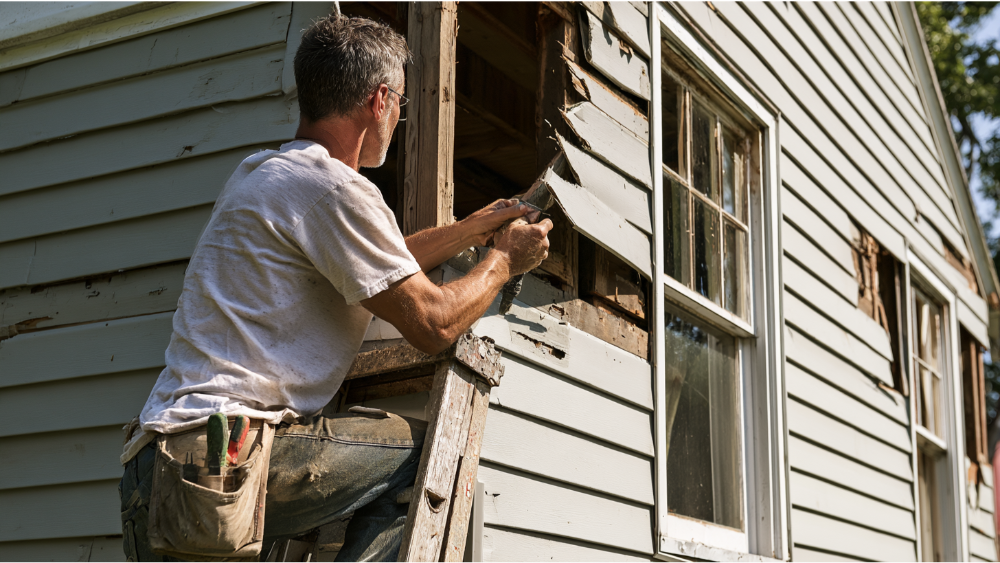
Full tear-off is the approach that lets the installer actually see the wall. It’s also the only way to properly integrate house wrap and new flashing, because both need to lap over the sheathing and around openings in the correct order.
Old siding removal and disposal fees are typically quoted separately, often per square foot of wall area, so confirm in writing whether a bid includes haul-off. Layering new siding over existing siding is sometimes offered as a way to save money. It conceals exactly the conditions you want discovered, and it complicates flashing at every window and door.
What Hidden Problems Show Up After the Old Siding Comes Off?
Tear-off is the inspection. Common finds include water staining and intrusion, rotted or deteriorated sheathing, failed or missing flashing above windows and doors, pest damage, an uneven or unsuitable substrate, and house wrap that’s degraded or was never installed correctly. Consumer Reports notes the same thing: removal is what reveals sheathing that needs repair.
No honest contractor can price concealed conditions in advance. That’s why setting aside a 10% to 15% contingency is standard planning advice, and it’s the most practical way to avoid unexpected expenses mid-project. The change-order process matters more than the headline number. A contractor worth hiring photographs the condition, prices it against a pre-agreed unit rate, and gets your written authorization before anyone picks up a saw.
Older Homes: Lead-Safe and Asbestos Considerations
For paid renovation work on pre-1978 housing, EPA Renovation, Repair and Painting requirements generally apply when more than 20 square feet of exterior painted surface is disturbed, unless the components are properly determined to be lead-free. Removing newer siding can trigger this if older painted siding sits underneath. If asbestos-containing material is suspected, EPA recommends evaluation and sampling by a trained, accredited professional. State and local rules may add requirements on top of the federal ones.
What Should Be Included in a Complete Siding Replacement Estimate?
Take this list to every bid you collect.
- Exact product line, profile, and color, not a generic reference to premium vinyl siding
- Measured exterior wall square footage in square feet and in squares
- Material cost and labor costs identified as separate lines
- Tear-off, haul-off, and disposal of the old siding
- House wrap or other weather-resistive barrier, named by product
- Flashing at windows, doors, and penetrations
- Trim, corners, soffit, fascia, and accessories
- Sheathing repair process and unit pricing for concealed damage
- Insulation or air-sealing scope, if any
- Building permits and inspections
- Site protection and daily cleanup
- Manufacturer product warranty
- Written workmanship warranty
- Change-order terms and payment schedule
When two bids differ sharply, the gap is almost always somewhere in that list. Rarely in the panels.
Should You Repair or Replace Your Vinyl Siding?
Condition tells you more than age does when you’re deciding whether to patch or replace vinyl siding. Ignore rules of thumb that say siding past a certain birthday must come off.
Repair may be appropriate when:
- Damage is isolated to a few panels or one elevation
- Matching panels in the same color and profile are still available
- The surrounding panels remain flexible and securely fastened
- There’s no sign of moisture behind the wall
Replacement usually makes more sense when:
- Damage or fading is widespread across elevations
- Panels are brittle, warped, loose, or failing repeatedly
- Color and profile can no longer be matched
- You suspect water is getting behind the cladding
- You want a siding material and design upgrade while the walls are open
Which Siding Material Makes Sense: Vinyl, Wood, Engineered Wood, or Fiber Cement?
Vinyl siding is a legitimate product with a real standard behind it. ASTM D3679-25 is the current specification for rigid PVC siding, covering dimensions, impact strength, expansion, weathering, and wind-load resistance, and it directs installers to follow the manufacturer’s product-specific instructions. Vinyl siding earns its popularity on minimal maintenance and a moderate material cost. Comparing different siding materials side by side is the clearest way to see what your house siding budget is really buying.
| Siding Material | Installed Cost Tier | Maintenance | Finish Longevity | Fire Performance |
|---|---|---|---|---|
| Vinyl siding panels | Moderate | Low | Varies by grade; fading possible | Combustible; can melt under heat exposure |
| Aluminum | Moderate | Low | Finish can chalk; dents show | Noncombustible metal |
| Wood siding | Higher | High; periodic refinishing | Depends entirely on upkeep | Combustible |
| Engineered wood siding | Higher | Moderate | Factory finishes available | Combustible |
| Fiber cement | Premium | Low | Long, with factory-applied finishes | Noncombustible |
| Stone veneer (accent use) | Premium | Low | Very long | Noncombustible |
Natural wood delivers an authentic look and asks for ongoing refinishing in return. Engineered wood binds wood fibers with resins for better dimensional stability, though it remains a combustible cladding.
What Vinyl Siding Installation Involves
Vinyl siding installation looks simple and isn’t. Panels are designed to hang rather than be pinned, with fasteners centered in the nailing slots and left slightly loose so the material can expand and contract through the seasons. Starter strip, J-channel, corner posts, and overlap direction all have to be right, and house wrap has to be lapped shingle-style behind all of it. Pin the panels tight and you get buckling in summer and cracked butt ends in winter, which is why professional installation matters more than the panel grade you picked. DIY installation tempts homeowners who see parts that appear to snap together, but flashing and fastening mistakes are expensive to undo.
Fiber cement is the upgrade many homeowners choose when they replace vinyl siding, and the reasoning is long-term. It’s noncombustible, dimensionally stable, durable and low maintenance, and James Hardie backs its siding with a transferable 30-year non-prorated limited substrate warranty, with ColorPlus® Technology finishes carrying a 15-year limited finish warranty covering paint and labor against specified finish failures. FEMA identifies fiber cement and cement-board cladding as a noncombustible or ignition-resistant exterior option, and post-fire assessments have observed vinyl melting under wildfire exposure while fiber cement generally performed better. A fire resistant siding material is one component of a fire resistant wall assembly, not a guarantee on its own.
Is Insulated Vinyl Siding Worth the Upfront Cost?
The Vinyl Siding Institute defines insulated vinyl siding as continuous insulation providing a minimum of R-2.0. Siding replacement is a genuine opportunity to improve energy efficiency by adding insulation on the exterior and tightening air sealing, as DOE guidance notes, but thicker wall assemblies demand more complex detailing at jambs, sills, and flashing, which adds scope and labor costs. Energy savings depend on your existing assembly, your climate, and how carefully the air sealing is executed, so treat lower utility bills as a reasonable expectation rather than a fixed figure. Note that the federal Energy Efficient Home Improvement Credit is not allowed for property placed in service after December 31, 2025. Check with the IRS or a tax professional before counting on any incentive.
Does Replacing Siding Increase Home Value?
The 2025 Cost vs. Value report models a standardized project covering 1,250 square feet of wall, including factory trim at openings and corners. It reported approximate national cost recovery of 97% for vinyl siding replacement and 114% for fiber cement siding replacement. Older guides citing figures closer to 80% reflect earlier editions and different assumptions.
These are modeled national averages, not a promise for your house or your sale. The benefit you actually live with is more immediate: restored curb appeal, less maintenance, and a wall assembly that’s finally detailed to shed water.
Why Siding Installation Quality Affects What the Project Really Costs
Siding isn’t the primary waterproof layer. The U.S. Department of Energy describes exterior cladding as part of a system with a continuous drainage plane behind it, integrated with flashing at windows, doors, penetrations, and wall transitions. Water that gets past the panels is supposed to drain down and out. If the barrier is interrupted or the flashing laps the wrong way, it doesn’t.
Fastening and expansion matter just as much. ASTM D3679-25 and the manufacturer’s written instructions both govern siding installation, and ignoring either can void a warranty. Errors surface years later as moisture damage and a second project, which is the most expensive version of siding replacement cost there is. Premium materials only perform when the crew that installs them respects the details.
That’s why we install siding the way the manufacturer specifies, every time. Our certified installers follow James Hardie’s published requirements, and we back the work with a 15-year workmanship warranty.
How Should You Compare Siding Contractors and Their Estimates?
- Get written, itemized estimates from at least three contractors.
- Verify licensing, bonding, and insurance, and ask for the license number in writing.
- Check product-specific credentials, not just years in business. A James Hardie Alliance Select Contractor designation, for example, is issued by the manufacturer and requires meeting standards for installation expertise, customer service, and business practices.
- Normalize the scope using the checklist above before you compare a single number, then convert each bid to a cost per square foot installed.
- Read both warranties: the manufacturer’s material coverage and the contractor’s workmanship coverage.
- Ask exactly how concealed damage will be documented, priced, and authorized.
Homeowners often ask whether booking in the off season changes anything. It can affect scheduling and crew availability more than it changes scope, and scope is what you’re really buying. The lowest initial number is only meaningful if it covers the same work.
Get a Project-Specific Free Estimate
You want an exterior that protects your home for decades and looks right doing it. We’re a family-owned exterior remodeling company that specializes in James Hardie fiber cement siding and Anlin window and door replacement. Two disciplines, mastered, rather than a long list spread thin.
We’re a James Hardie Alliance Select Contractor and an Anlin Authorized Dealer, licensed, bonded, and insured under California General Building License #1092104, and BBB A+ rated. Our work carries a 15-year workmanship warranty, with a 30-year material warranty available on James Hardie siding. We measure your actual exterior wall square footage and put the full scope in writing, line by line, so you know what you’re approving. Financing is available; contact us for details.
Get Your Free Estimate Today. Call Modern Construction Group at (916) 699-7070.
Frequently Asked Questions
How Much Does Vinyl Siding Cost for a 2,000 Square Foot House?
A home’s 2,000 square foot floor area doesn’t tell a contractor how much siding it needs. A two-story house with large gables can have far more exterior wall square footage than a single-story home of identical floor area. The real siding cost comes from a measured takeoff in squares, plus tear-off, trim, flashing, and any repairs found behind the old panels.
How Is Vinyl Siding Cost per Square Foot Calculated?
Divide the all-in bid by the measured wall area and you have a cost per square foot installed. That figure bundles material cost, labor costs, tear-off, accessories, and overhead, so it’s only useful for comparing bids that cover identical scope. Two contractors quoting the same price per square foot can still be selling very different projects.
What’s the Average Lifespan of Vinyl Siding?
There’s no single honest number. Service life varies by product grade, sun exposure, impact history, and how well it was installed. Condition indicators tell you far more than age: brittleness, warping, widespread fading, loose panels, repeated repairs, and any evidence of moisture behind the wall.
Does Homeowners Insurance Cover Vinyl Siding Replacement?
Coverage generally depends on the cause of loss. Sudden, accidental damage from a covered peril may be considered, while wear, age, fading, and deferred maintenance typically are not. Matching provisions also vary by policy, so review your coverage and speak with your carrier or agent before assuming anything.
Is It Worth Replacing the Siding on a House?
For most homeowners with failing panels or suspected moisture, yes. The 2025 Cost vs. Value report places siding replacement among the stronger exterior projects for cost recovery, with roughly 97% for vinyl siding and 114% for fiber cement as modeled national averages. Beyond resale, you get restored curb appeal, lower maintenance, and a properly detailed wall assembly.
Facts verified as of October 2026. Standards, incentives, and resale data change. Verify before relying on them.